A consumer unit upgrade does not automatically mean your whole house needs rewiring. In many properties, an electrician can replace an older fuse box while keeping the existing cables and circuits. However, the wiring must first pass the necessary inspection and electrical tests.
Therefore, the answer to can I upgrade my consumer unit without rewiring my house depends on the condition of the existing installation. Some homes only need a modern consumer unit, while others require repairs or improvements before the new unit can be safely connected.
West Coast Electrical & Renewables carries out consumer unit upgrades across Blackpool, Poulton le Fylde, Thornton Cleveleys, Lytham St Annes and the wider Fylde Coast.
The simple answer
Yes, you can often upgrade a consumer unit without rewiring the house.
The electrician must assess the existing wiring before making that decision. The age of the cables alone does not always determine whether they need replacing. Instead, their condition, test results and suitability for continued use are more important.
Electrical Safety First guidance states that existing circuits connected to a replacement consumer unit should undergo appropriate inspection and testing. This allows the electrician to identify faults that could affect the safety or operation of the new equipment.
What is a consumer unit?
The consumer unit, sometimes called a fuse box, distributes electricity around your property. It contains protective devices for circuits such as:
- Lighting
- Plug sockets
- Cookers and ovens
- Electric showers
- Outdoor supplies
- EV chargers
- Solar and battery equipment
Older fuse boxes may contain rewireable fuses or basic circuit breakers. In contrast, a modern consumer unit can include devices such as RCBOs, RCD protection and surge protection where required by the system design.
These devices provide important protection against different types of electrical fault. However, fitting a modern consumer unit does not repair damaged or unsuitable wiring elsewhere in the property.
What happens before a consumer unit upgrade?
Before replacing the unit, the electrician needs to find out whether the existing circuits are suitable for reconnection.
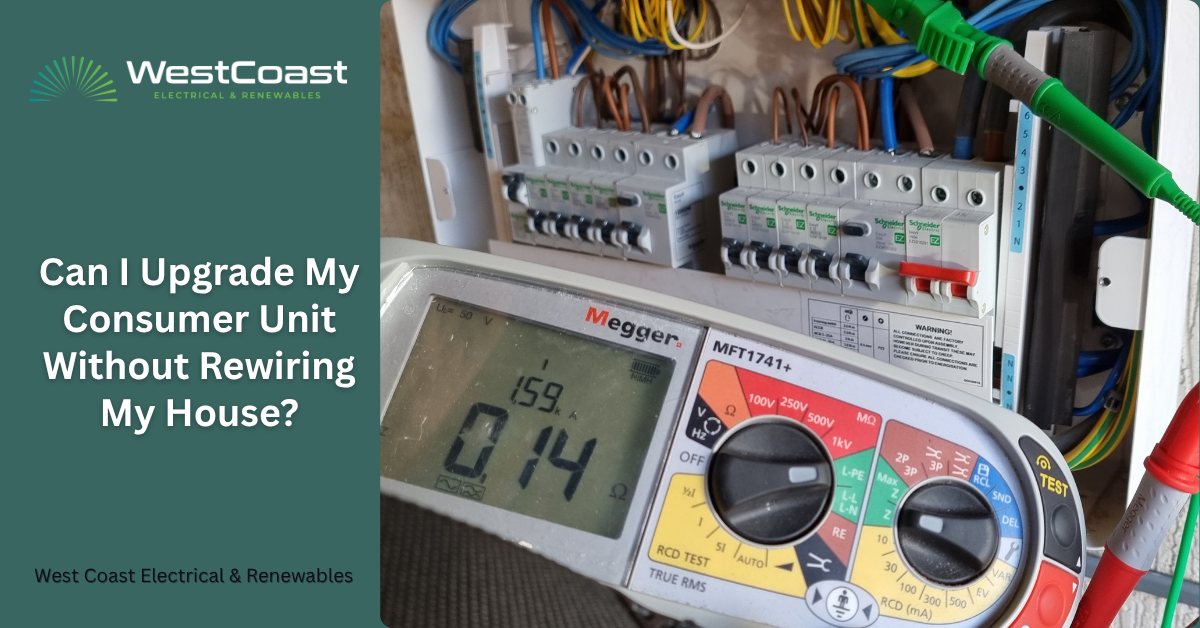
This usually involves inspecting and testing the electrical installation. The electrician may check:
| Check | Why it matters |
|---|---|
| Earthing and bonding | Confirms that important protective arrangements are present and suitable |
| Cable insulation | Helps identify damaged or deteriorated wiring |
| Circuit continuity | Confirms that protective conductors and circuit paths are complete |
| Polarity | Checks that connections have been made correctly |
| Existing faults | Identifies problems that could cause the new protective devices to trip |
| Circuit identification | Ensures each circuit can be correctly connected and labelled |
| Consumer unit location | Confirms that the new equipment can be installed safely and accessed when needed |
The tests may reveal that the existing wiring remains serviceable. In that case, a full rewire may not be necessary.
However, if testing identifies faults, the electrician will explain what needs correcting before or during the upgrade.
Why can a new consumer unit reveal existing problems?
Older fuse boxes do not always provide the same level of fault detection as modern protective devices.
For example, an existing circuit may appear to work normally with an older fuse board. Once connected to modern RCD or RCBO protection, the same circuit may trip because the new device detects leakage or another underlying fault.
This does not mean the new consumer unit has caused the problem. Instead, it may have revealed an issue that the previous equipment did not detect.
Therefore, proper testing before the upgrade helps reduce unexpected disruption and allows any necessary repairs to be discussed in advance.
Does old wiring always need replacing?
No. Older wiring is not automatically unsafe simply because of its age.
Some older installations remain in a serviceable condition, particularly where qualified electricians have maintained and altered them carefully. Meanwhile, newer wiring can still develop problems through damage, poor workmanship or unsuitable alterations.
An electrician should base the recommendation on inspection and test results rather than appearance alone.
However, a rewire or partial rewire may be recommended when the wiring:
- Has damaged or deteriorated insulation
- Does not provide suitable earthing
- Contains unsafe alterations
- Cannot support the property’s current electrical demands
- Has serious faults across several circuits
- Requires extensive repairs throughout the property
A full house rewire is a significant project and should only be completed by a qualified and competent electrician.
Need your consumer unit checked?
An older fuse box does not always mean you need a complete rewire. We can inspect your installation, carry out the necessary tests and explain whether a consumer unit upgrade is suitable.
You will receive straightforward advice based on the condition of your wiring, rather than an automatic recommendation to replace everything.
Will I need an EICR first?
An Electrical Installation Condition Report and the testing required for a consumer unit replacement are related, but they are not the same document.
An EICR provides a broader report on the condition of an existing electrical installation. By comparison, replacing a consumer unit requires testing and certification connected to the alteration itself.
In some situations, arranging an EICR before the work can be useful, particularly if the installation is older, its history is unknown or there are signs of existing electrical problems. However, the appropriate approach depends on the individual property.
It is also worth noting that an Electrical Installation Certificate for a replacement consumer unit is different from an EICR.
What improvements can a modern consumer unit provide?
A consumer unit upgrade can improve how your electrical system responds to faults. Depending on the design, the new unit may include individual RCBO protection for each circuit.
With individual RCBOs, a problem on one circuit should not automatically disconnect several unrelated circuits. For example, an outdoor fault may trip that particular circuit while leaving your lights and other sockets available.
A new consumer unit can also provide space for future electrical work. This may be useful if you are planning:
- An EV charger
- Solar panels
- Battery storage
- An air source heat pump
- An extension
- A new kitchen
- Additional outdoor electrics
However, the electrician must assess the overall installation and electrical demand before adding new circuits.
Will the work need electrical certification?
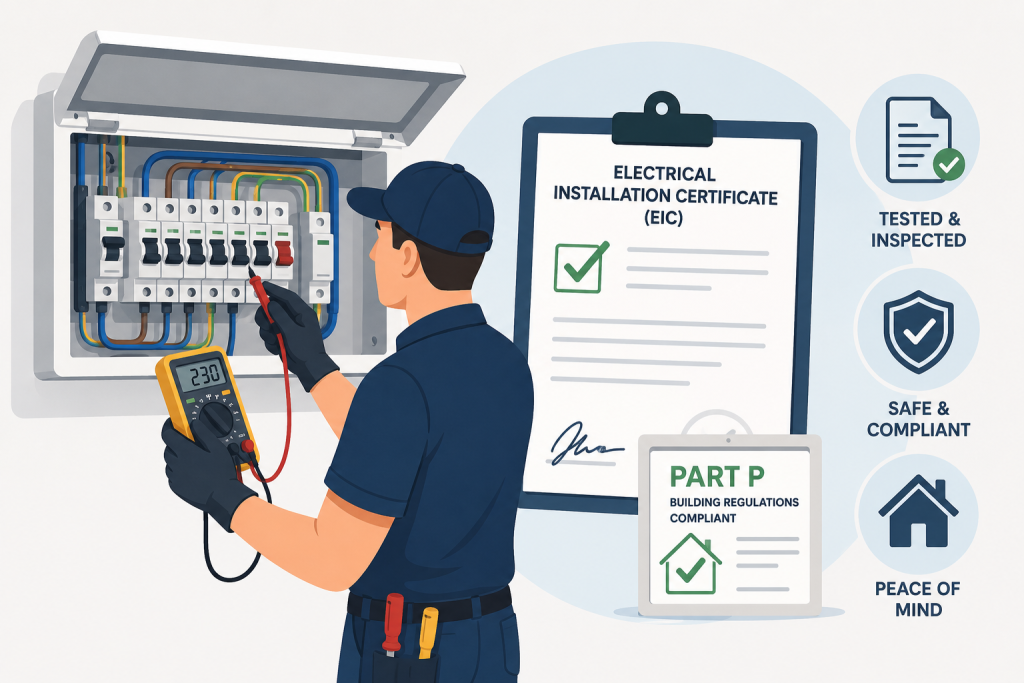
Yes. A consumer unit replacement requires inspection, testing and the appropriate electrical certification.
Changes to a consumer unit are also classed as notifiable electrical work under Part P of the Building Regulations in England. Registered installers can normally notify the work through their competent person scheme and arrange the relevant Building Regulations compliance certificate.
You should keep the electrical paperwork with your property documents after the work is complete.
How long does a consumer unit upgrade take?
The time required depends on the number of circuits, the condition of the installation and whether testing reveals any problems.
The electricity will need to be switched off while the electrician removes the old unit and connects the new one. Afterwards, each circuit must be tested, correctly labelled and checked before the supply is fully restored.
If faults require further investigation or repair, the work may take longer. Therefore, it is better to allow enough time for the job to be completed properly rather than viewing it as a simple equipment swap.
What if only part of the house needs rewiring?
Electrical work is not always a choice between keeping everything and rewiring the entire property.
Sometimes, most circuits pass the required tests while one or two need attention. In this situation, the electrician may recommend targeted repairs or a partial rewire.
For example, an older kitchen circuit may need replacing while the upstairs lighting and socket circuits remain suitable. This approach can address the unsafe or unsuitable parts of the installation without disturbing areas that continue to perform correctly.
Consumer unit upgrades in Blackpool and the Fylde Coast
So, can I upgrade my consumer unit without rewiring my house? In many cases, yes. A full rewire is not an automatic requirement when replacing an older fuse box.
However, the existing wiring must be inspected and tested before it is connected to modern protective equipment. If the circuits are in a suitable condition, they may remain in use. If faults are found, your electrician should explain the necessary repairs and provide clear advice before continuing.
West Coast Electrical & Renewables carries out consumer unit replacements, electrical testing, fault finding and rewires throughout Blackpool, Poulton le Fylde, Thornton Cleveleys, Lytham St Annes and nearby areas. We assess each installation individually, so you understand exactly what work your property needs.