You are making dinner and suddenly the power goes off. You reset the switch at the consumer unit, everything comes back on, then it happens again.
If your electrics keep tripping, your electrical system is usually responding to a fault or abnormal condition somewhere within the installation. It might be linked to an appliance, a particular circuit or an issue that needs further investigation.
An occasional trip does not always mean there is a serious electrical problem. However, if the same switch keeps tripping, you should not simply keep resetting it without trying to establish why.
At West Coast Electrical & Renewables, electrical fault finding is one of the services we provide across Blackpool and the surrounding areas. Here are some of the common reasons your electrics may keep tripping and what you should do next.
What does it mean when your electrics trip?
Modern consumer units contain protective devices designed to disconnect the electricity supply when certain electrical faults or unsafe conditions occur.
Depending on your consumer unit, you may have circuit breakers, RCD protection, RCBOs or a combination of protective devices.
When one of these devices operates, you may lose power to one circuit or several areas of your property.
Instead of seeing the trip itself as the problem, it is better to think of it as a warning that something has caused the protective device to operate.
Common reasons your electrics keep tripping
There is no single reason for electrical tripping. However, the pattern can sometimes give you an indication of where the problem may be.
| What you notice | Possible cause |
|---|---|
| Power trips when you turn on one appliance | The appliance or its supply could have a fault |
| One circuit repeatedly trips | There may be a fault affecting that circuit |
| Electrics trip when several appliances are running | The circuit may be overloaded |
| Power trips during or after wet weather | Water ingress or an external electrical issue may need investigating |
| Outside lights cause the electrics to trip | There could be a problem with the fitting, cable or connection |
| The RCD keeps tripping | An electrician may need to test the circuits and appliances to locate the fault |
| The electrics trip randomly | Further electrical fault finding may be required |
This table can help narrow down the circumstances, but it cannot diagnose an electrical fault. Proper testing may still be necessary to establish the cause.
Could an appliance be causing the problem?
Yes. Faulty appliances are one potential cause of repeated electrical tripping.
For example, you might notice that everything works normally until you switch on the kettle, washing machine, oven or another appliance.
If the trip happens consistently when you use the same appliance, stop using it until the cause has been established.
However, the appliance itself is not always responsible. The problem could also relate to the socket, circuit or electrical installation supplying it.
Therefore, if you are unsure, it is safer to have the issue checked rather than assuming the appliance needs replacing.
What if one circuit keeps tripping?
Your consumer unit separates your electrical installation into different circuits. Depending on the property, these could include lighting, sockets, cooking appliances, showers and other electrical equipment.
If the same circuit breaker or RCBO repeatedly trips, the fault may relate to something connected to that particular circuit.
For example, if your downstairs socket circuit keeps tripping, an electrician can carry out testing to help identify where the fault is occurring.
Electrical fault finding is often a process of narrowing down the possibilities. Testing allows an electrician to investigate the circuit rather than simply replacing parts and hoping the problem disappears.
Can too many appliances cause the electrics to trip?
In some situations, a circuit can trip because the electrical demand exceeds what the protective device or circuit is designed to handle.
This may become more noticeable at certain times of year.
During winter, for example, households may use more portable heaters, cooking equipment, tumble dryers and other electrical appliances. Christmas can also introduce additional decorative lighting and electrical equipment into the home.
However, repeated tripping should not automatically be dismissed as simply using too much electricity.
If you are regularly experiencing the same problem, an electrician can assess the circuit and investigate what is causing the protective device to operate.
Why do my electrics trip when it rains?
If you notice a connection between wet weather and your electrics tripping, it is worth getting the issue investigated.
External sockets, garden lighting, security lights, outdoor connections and other electrical equipment are exposed to more challenging conditions than equipment inside your home.
Water ingress or deterioration could potentially cause a fault.
This is particularly relevant around Blackpool and the Fylde Coast, where external electrical installations can face wet, windy and coastal conditions throughout the year.
Do not repeatedly reset a circuit if it continues to trip during wet weather. Instead, arrange for the affected installation to be checked.
What should I do when my electrics trip?
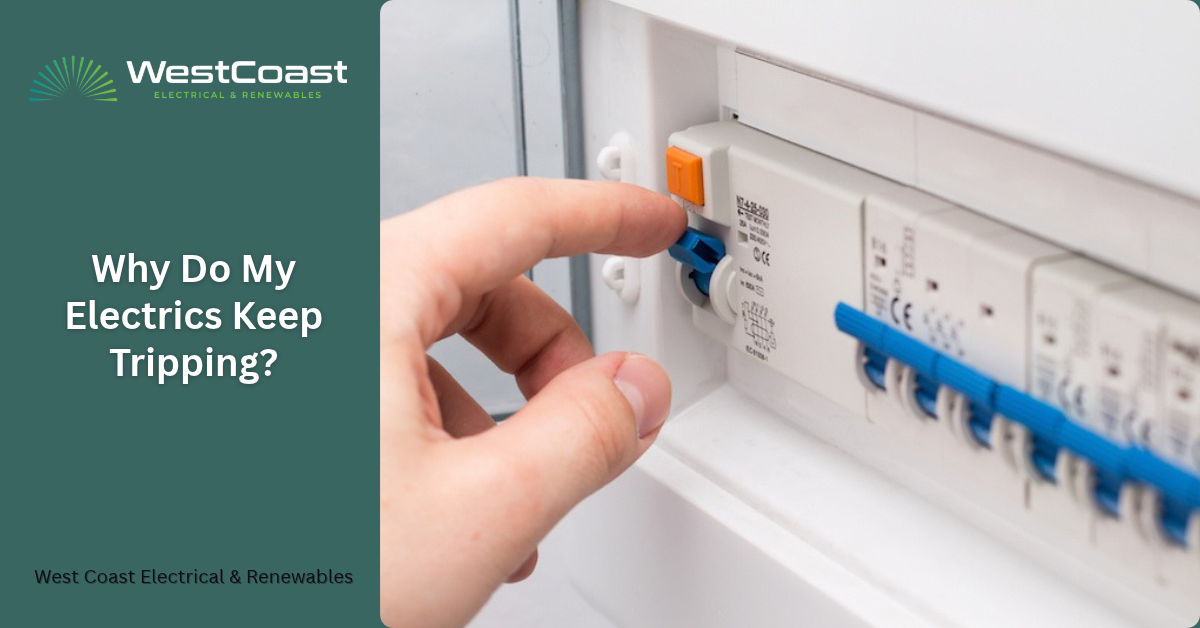
First, check your consumer unit to see which protective device has operated.
Think about what was happening immediately before the power went off. Did you turn an appliance on? Had you just switched on an outside light? Does the same circuit trip every time?
These details can be extremely useful when you speak to an electrician.
You should never remove the consumer unit cover or attempt electrical repairs yourself.
If there is a burning smell, visible damage, signs of overheating or another immediate electrical safety concern, do not continue resetting the circuit.
Why does the switch go straight back off when I reset it?
If you reset a protective device and it immediately operates again, there may still be an active fault on the circuit.
Repeatedly forcing the switch back on will not fix the underlying problem.
At this stage, electrical testing may be needed to establish what is causing the protective device to operate.
Sometimes the cause can be relatively straightforward. Other faults require more detailed investigation, particularly when the problem is intermittent.

How does an electrician find an electrical fault?
Electrical fault finding involves testing and investigating the installation to narrow down the source of a problem.
The exact process depends on the symptoms and the type of installation. An electrician may need to test circuits, inspect accessories, check connections or investigate individual pieces of equipment.
Importantly, professional testing provides information that you cannot get simply by looking at the consumer unit.
Once the cause has been identified, the electrician can explain what needs repairing and whether any further work is recommended.
Electrical fault finding in Blackpool
West Coast Electrical & Renewables provides electrical fault finding for homes and businesses across Blackpool, Poulton le Fylde, Thornton Cleveleys, Lytham St Annes and surrounding areas.
Our electrical team works on everything from small domestic faults to larger commercial electrical installations.
We can investigate issues including circuits that repeatedly trip, socket and lighting faults, problems with consumer units, external electrical faults and unexplained power loss.
We also offer remote troubleshooting via WhatsApp in suitable situations. This can help us understand what is happening before deciding what the next step needs to be.
So, if your electrics keep tripping, do not ignore it or simply get into the habit of resetting the switch. Finding out why it is happening is the best way to determine what needs to be done.
Need help with electrics that keep tripping?
If your electrics keep tripping or you have an electrical fault that you cannot identify, our team can help.
West Coast Electrical & Renewables provides professional electrical fault finding across Blackpool and the surrounding areas.