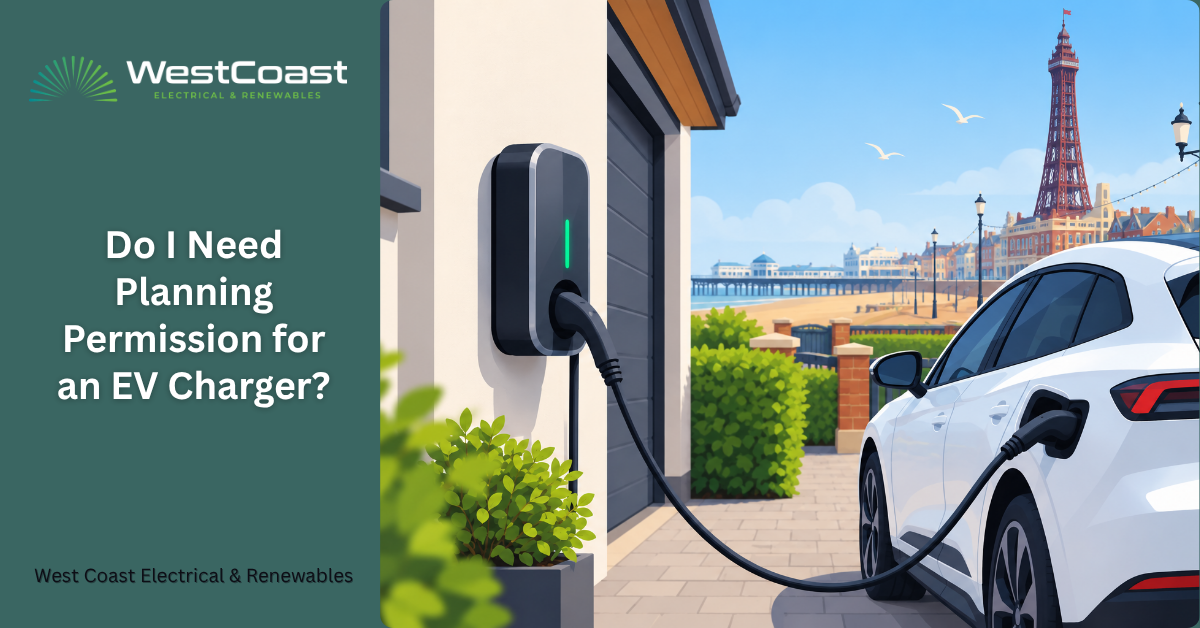
If you are considering installing an electric vehicle charger at home, you may be wondering whether you need to contact your local council first. In many situations, planning permission for an EV charger is not required because the installation can fall within permitted development rights in England. However, there are conditions and exceptions, so it is important to consider where the charger will be installed and the type of property you live in.
At West Coast Electrical & Renewables, we install home EV chargers across Blackpool, Poulton le Fylde, Thornton Cleveleys, Lytham St Annes, Preston and surrounding areas. As part of planning an installation, we consider the proposed charger position, cable route and existing electrical installation.
Do I Need Planning Permission for an EV Charger at Home?
For many homeowners, the answer will be no.
EV charger installations can benefit from permitted development rights in England. Permitted development allows certain types of work to take place without making a full planning application, provided the installation meets the relevant conditions.
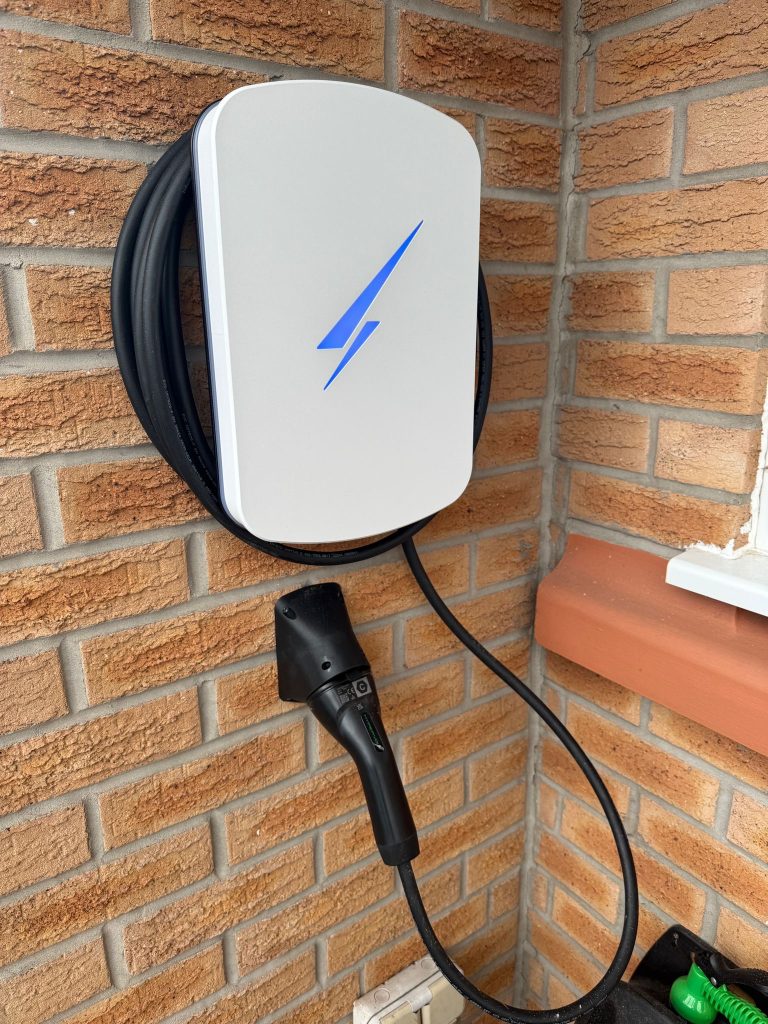
The rules cover wall-mounted EV charging outlets as well as chargers mounted on an upstand.
However, permitted development rights have specific limitations. Therefore, you should not assume that every EV charger installation is automatically covered.
Your property type and the proposed charger location both matter.
EV Charger Planning Rules Changed in 2026
The permitted development rules for electric vehicle charging infrastructure were updated in September 2026.
The changes extended the circumstances where permitted development rights can apply to EV charging equipment. Previously, the rights focused on areas lawfully used for off street parking.
Under the updated rules, a wall mounted EV charging outlet can potentially fall within permitted development rights when installed within an area lawfully used for off street parking or elsewhere within the curtilage of a dwellinghouse or block of flats, subject to the relevant restrictions.
The updated rules also cover upstands used for EV charging.
This is useful for homeowners because properties and parking arrangements vary considerably. However, the rules still include important limitations, particularly around listed buildings, scheduled monuments, conservation areas and charger positioning.
Are There Size Restrictions for a Wall Mounted EV Charger?
Yes.
Under the permitted development rules, a wall mounted charging outlet and its casing must not exceed 0.2 cubic metres.
The updated 2026 rules also introduce a maximum installation height. A wall mounted charging outlet cannot be installed more than 1.6 metres above ground level if the installation is relying on these permitted development rights.
Most standard domestic EV chargers are relatively compact. Therefore, the physical size of a typical home charger may not be the main issue.
However, location remains important.
What If My House Is Listed?
Listed buildings need additional consideration.
Permitted development rights for an EV charging outlet do not apply where the charger would be within the curtilage of a listed building.
As a result, you should not assume that you can install an EV charger at a listed property without first checking the relevant permissions.
Listed building consent may also need consideration depending on the work proposed and how it affects the listed building.
If you live in a listed property and want an EV charger, it is sensible to speak to your local planning authority before work begins.
What About Conservation Areas?
Conservation areas can also affect what you are allowed to install.
The latest rules contain specific restrictions relating to some EV charger installations within conservation areas. In addition, local planning controls can affect permitted development rights.
Therefore, if your property sits within a conservation area, it is worth checking the position before arranging an installation.
This does not automatically mean you cannot have an EV charger. Instead, it means the installation may need additional consideration or permission.
What If the Charger Is Near a Highway?
EV charger planning rules have changed over recent years, including changes affecting installations close to highways.
As a result, older online articles about EV charger planning permission may no longer reflect the current rules.
However, the position of the charger still matters.
For example, the latest rules include restrictions where an outlet would be mounted on a wall of a dwellinghouse or block of flats that immediately adjoins a highway.
There are also practical considerations beyond planning permission. Charging cables should not simply create an obstruction or trip hazard across a pavement or other public area.
Therefore, where a property does not have a straightforward private parking arrangement, additional assessment may be necessary.
Can I Install an EV Charger Without a Driveway?
This depends on the property.
Traditionally, home EV charging has been most straightforward for properties with off-street parking. However, charging options are continuing to develop for properties without conventional driveways.
Planning permission is only one consideration.
If a charging cable would need to cross a public pavement or highway, you cannot simply run a loose cable across the pavement because it could create a hazard.
Some local authorities are introducing or considering approved cross pavement charging solutions. However, availability and requirements can vary between councils.
Therefore, homeowners without off street parking should check the arrangements available through their local authority before assuming a home charger can be installed.
What Is an EV Charger Upstand?
Not every EV charger needs to be fixed directly to a house or garage.
An upstand is a post or pedestal that supports the EV charging outlet. This can provide an alternative where there is no suitable wall next to the parking space.
For domestic locations, the current permitted development rules include a height limit of 1.6 metres for an upstand and charging outlet where the installation is within the curtilage of a dwellinghouse or block of flats.
Different limits can apply in non domestic off street parking areas.
The correct solution will depend on the property, parking arrangement and charger location.
Does Planning Permission Mean My Electrical Installation Is Suitable?
No. These are two separate considerations.
Even when an EV charger falls within permitted development rights, the electrical installation still needs to be assessed.
Before installing an EV charger, we consider factors such as the existing consumer unit, electrical supply, proposed cable route and the electrical demand at the property.
Modern EV charging installations can also incorporate load management. This allows the charger to manage its demand in relation to the electricity being used elsewhere in the property.
Depending on the existing installation, additional electrical work may also be necessary.
Therefore, planning permission is only one part of preparing for an EV charger installation.
Which EV Chargers Do We Install?
Different homes need different EV charging solutions.
At West Coast Electrical & Renewables, we install a range of home EV chargers, including Hypervolt, Easee and Simpson & Partners.
Hypervolt remains a popular choice for many of our customers. However, the right charger depends on what you need from the installation.
For example, some homeowners prioritise smart tariff integration and app controls. Others want a particular cable length, appearance or charging setup.
Meanwhile, the location of the charger can also influence the best option.
We can discuss the available chargers and help you choose one that suits your property, vehicle and requirements.

Do I Need Permission From Anyone Else?
Planning permission is not always the only permission to consider.
For example, if you rent your home, you would normally need permission from the property owner before installing permanent charging equipment.
Leasehold properties can also have additional requirements. You may need to check the terms of your lease or speak with the freeholder or managing agent.
Flats and developments with communal parking can be more complicated because the parking area, walls or electrical infrastructure may not belong solely to one resident.
Therefore, it is worth establishing who owns the proposed installation area before arranging the work.
What If I Am Still Unsure About Planning Permission?
If there is any uncertainty, your local planning authority should be able to advise you on the planning position for your property.
This is particularly important if you have a listed building, live within a conservation area or have an unusual parking arrangement.
You can also apply for a Lawful Development Certificate where appropriate if you want formal confirmation that proposed work is lawful.
It is better to establish the position before installation rather than discovering afterwards that permission should have been obtained.
EV Charger Installation in Blackpool and Lancashire
For many standard domestic properties, installing an EV charger is relatively straightforward and a full planning application will not be required.
However, every property is different.
West Coast Electrical & Renewables installs EV chargers across Blackpool, Poulton-le-Fylde, Thornton Cleveleys, Lytham St Annes, Preston and surrounding areas of Lancashire.
We can assess the proposed charger position, cable route and electrical installation before providing a quotation.
If your property has unusual planning considerations, such as listed status or a conservation area location, these should be checked before work begins.

Looking for an EV Charger Installer?
If you are considering an EV charger at home, West Coast Electrical & Renewables can help you choose a suitable charger and assess the electrical requirements for the installation.
We offer a range of EV charging options, so you are not restricted to one manufacturer. We can look at your property, where you park and where you would like the charger positioned before advising on the installation.
For properties where planning permission may be required, we recommend confirming the position with your local planning authority before installation.