Your solar panels are producing more electricity than your home needs. So where does the rest of that electricity actually go?
It is a question we hear regularly, particularly from customers trying to understand how to make the best use of their solar PV system. The answer depends on how your system has been designed, whether you have battery storage and what export arrangements are in place.
Excess solar energy does not simply disappear. Depending on the system, it can be stored in a battery for later use or exported to the electricity network. Therefore, understanding how these different parts work together is an important part of designing the right solar installation.
What Is Excess Solar Energy?
Solar panels generate electricity whenever there is enough daylight. However, the amount generated will change throughout the day and across the seasons.
At the same time, your home’s electricity demand constantly changes.
For example, your solar panels could be generating 4kW while your property is only using 1kW. In this situation, there is approximately 3kW of solar generation available beyond the immediate demand of the property.
That electricity is what we mean when we talk about excess solar energy.
What happens next depends on the equipment installed and how the system has been configured.
Your Home Uses Solar Energy First
With a typical domestic solar PV system, electricity generated by the panels can supply electrical demand within the property.
So, if your panels are generating electricity while appliances are running, some of that solar generation can contribute towards powering those appliances.
As a result, you may need to import less electricity from the grid during periods of solar generation.
However, solar generation and household demand rarely match perfectly throughout the entire day. This is where battery storage and grid export become particularly useful.

Excess Solar Energy Can Be Stored in a Battery
Adding battery storage allows a household to store some excess solar energy instead of immediately exporting it to the grid.
For example, your solar panels may generate more electricity than you need during the middle of the day. A compatible battery can store some of that energy. Then, later in the day, when solar generation falls and electricity demand increases, the stored energy can be used within the property.
This can increase the amount of solar generation you use yourself.
However, battery storage should always be sized appropriately. Installing the largest battery available does not automatically make it the best option.
We look at factors such as annual electricity consumption, typical daily usage, solar array size, available tariffs, future plans and how the customer wants the system to operate.
What Happens When the Battery Is Full?
Eventually, a battery may reach its configured maximum state of charge.
If your solar panels are still generating more electricity than your home requires, the system then needs to manage that excess generation.
Subject to the system configuration and agreed export arrangements, excess electricity can usually be exported to the electricity distribution network.
This is one reason why solar, battery storage and grid connection requirements need to be considered together during the design stage.
Can I Export Excess Solar Energy to the Grid?
Yes, many solar PV systems export electricity that is not being used or stored at the property.
The electricity passes through the property’s metering arrangement and into the local distribution network.
Eligible homeowners may also be able to receive payment for electricity exported through an export tariff, such as one offered under the Smart Export Guarantee.
However, export tariffs vary between energy suppliers. Rates, eligibility requirements and terms can also change. Therefore, it is important to check the current tariff information directly with your chosen supplier rather than assuming a particular export rate.
A smart meter capable of recording export is also generally required for Smart Export Guarantee payments.
What Does G99 Have to Do With Solar Panels?
Before we install a solar PV system, one of the important considerations is how that system will connect to the local electricity distribution network.
The Distribution Network Operator, usually referred to as the DNO, manages the local electricity network.
Depending on the size and specification of the proposed generation system, the installation may fall under different Engineering Recommendation connection procedures.
G99 is particularly important for systems that require approval from the DNO before connection.
For applicable installations, we submit the required information to the DNO as part of the process before proceeding with the connection. This allows the network operator to assess the proposed system and determine whether it can connect as designed or whether specific export requirements are needed.
The application includes technical information about the proposed generation equipment and system design.
This process is important because the local electricity network was originally designed around electricity travelling from larger generators towards homes and businesses. As more properties generate their own electricity, network operators need to manage how much electricity can flow back onto different parts of the network.
What Is an Export Limit?
Sometimes the DNO may specify how much electricity a system can export to the network.
This does not necessarily mean that the solar array itself needs to be limited to that same size.
Instead, an approved export limitation arrangement can be used on suitable systems. The equipment monitors electricity flowing between the property and the grid and controls the system so that export stays within the agreed limit.
For example, a property could have a solar and battery system capable of operating above the permitted grid export level. The property may still be able to use generated electricity and store energy in its battery, while the system controls the amount allowed to leave the property.
The exact arrangement depends on the system design, equipment and DNO requirements.
This is why we consider grid connection requirements at the design stage rather than treating them as an afterthought.
G98 and G99 Are Not the Same Thing
You may also see G98 mentioned when researching solar installations.
Both G98 and G99 relate to connecting generation equipment to the electricity distribution network. However, which process applies depends on the generation equipment, capacity and connection arrangement.
Certain smaller generation systems that meet the relevant requirements can follow the G98 connection process. Other systems require the G99 process, which can involve obtaining permission before connection.
Therefore, it is not simply a case of deciding that every solar installation needs the same application.
As an MCS certified solar installer, West Coast Electrical & Renewables assesses the proposed system and follows the appropriate connection process for the installation.
Can You Choose Whether to Store or Export Solar Energy?
With the right solar and battery system, homeowners can have much more control over how energy moves around their property.
Modern battery systems and monitoring apps can show information such as solar generation, household consumption, battery charge level, electricity imported from the grid and electricity exported.
Depending on the equipment and tariff, systems can also be configured around different charging and discharging schedules.
For example, some households may choose to charge a battery during a cheaper overnight electricity period and then use or manage solar generation differently during the day.
However, the best approach varies considerably between households.
Electricity tariffs change, export rates differ between suppliers and every property has a different energy profile. Therefore, we prefer to design systems around real electricity usage rather than making general claims about which approach will save the most money.
Does Exported Solar Energy Get Wasted?
No. Electricity exported from your solar installation enters the wider electricity network where it can contribute to electricity demand elsewhere.
From the homeowner’s perspective, however, there is an important difference between using electricity within the property, storing it for later or exporting it.
This is why monitoring your system can be so useful.
Rather than simply seeing how much electricity your solar panels generated that day, you can get a much better understanding of where that energy went.
For example, you may be able to see how much was used by the property, how much charged the battery, how much was exported and how much electricity was imported from the grid.
Can You Get Paid for Excess Solar Energy?
Eligible solar PV owners can potentially receive payments for electricity exported to the grid through the Smart Export Guarantee or another suitable export tariff.
The Smart Export Guarantee requires participating electricity suppliers to offer eligible small scale generators a tariff for metered electricity exported to the grid.
However, there is no single fixed export rate that applies to everyone.
Energy suppliers set their own rates and terms. Some tariffs may also have additional eligibility requirements. Therefore, homeowners should compare current export tariffs and check the conditions carefully.
It is also worth remembering that your export supplier does not necessarily have to be the same company that supplies the electricity you import.
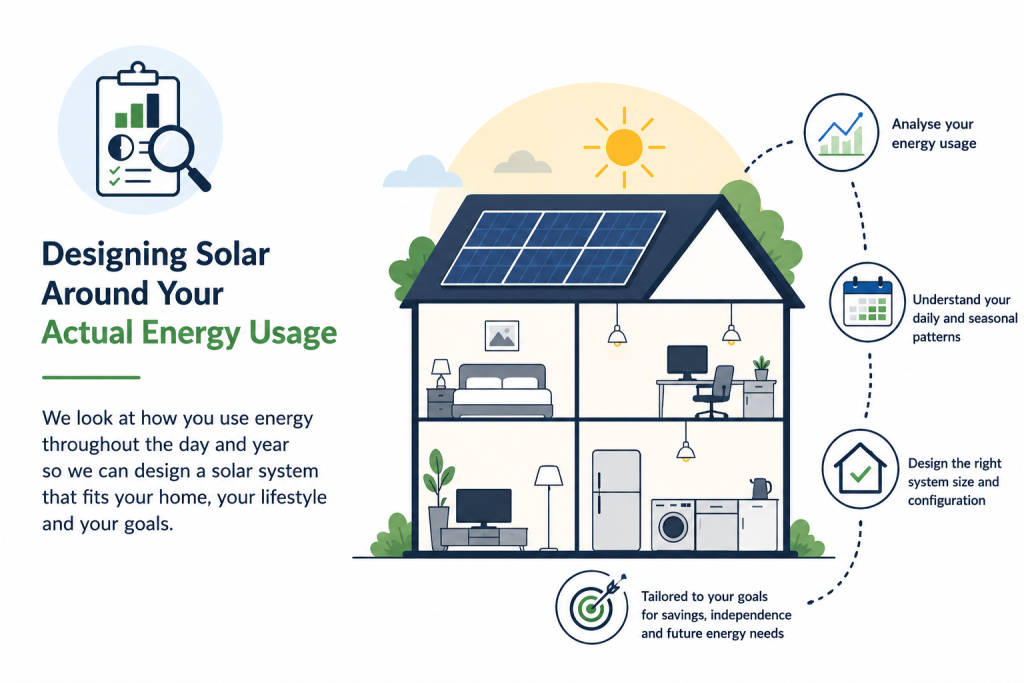
Designing Solar Around Your Actual Energy Usage
A good solar installation is about much more than fitting as many panels as possible.
Before recommending a system, we consider how much electricity the property uses, when that electricity is typically used and how much solar generation the available roof space could reasonably provide.
We can then look at whether battery storage would suit the property and how the proposed system will interact with the electricity network.
We also consider future requirements. For example, a household may be planning to purchase an electric vehicle, install an air source heat pump or increase electricity consumption in another way.
Taking these factors into account at the beginning can help create a system suited to both current and future energy requirements.
Solar PV and Battery Storage in Blackpool and Lancashire
West Coast Electrical & Renewables installs solar PV and battery storage systems across Blackpool, Poulton le Fylde, Thornton Cleveleys, Lytham St Annes and surrounding areas of Lancashire.
We are MCS certified and take care of the relevant solar installation process, including assessing the grid connection requirements for the proposed system.
Our team works with established solar and battery technology, including AlphaESS, Enphase and Tesla battery storage alongside high quality solar panels and mounting systems.
Most importantly, we design each installation around the individual property rather than offering the same solar package to every customer.
Make Better Use of Your Solar Generation
So, what happens to excess solar energy?
Depending on your system, electricity that your property does not immediately need can charge a battery or be exported to the electricity network. If you are eligible and registered for a suitable export tariff, you may also receive payment for metered electricity exported to the grid.
However, getting the best from solar starts before the panels go on the roof. System size, battery capacity, DNO requirements, G98 or G99 connection procedures, export limits and electricity tariffs can all influence how a system should be designed.
West Coast Electrical & Renewables can assess your property and electricity usage before recommending a solar and battery system designed around the way you actually use energy.