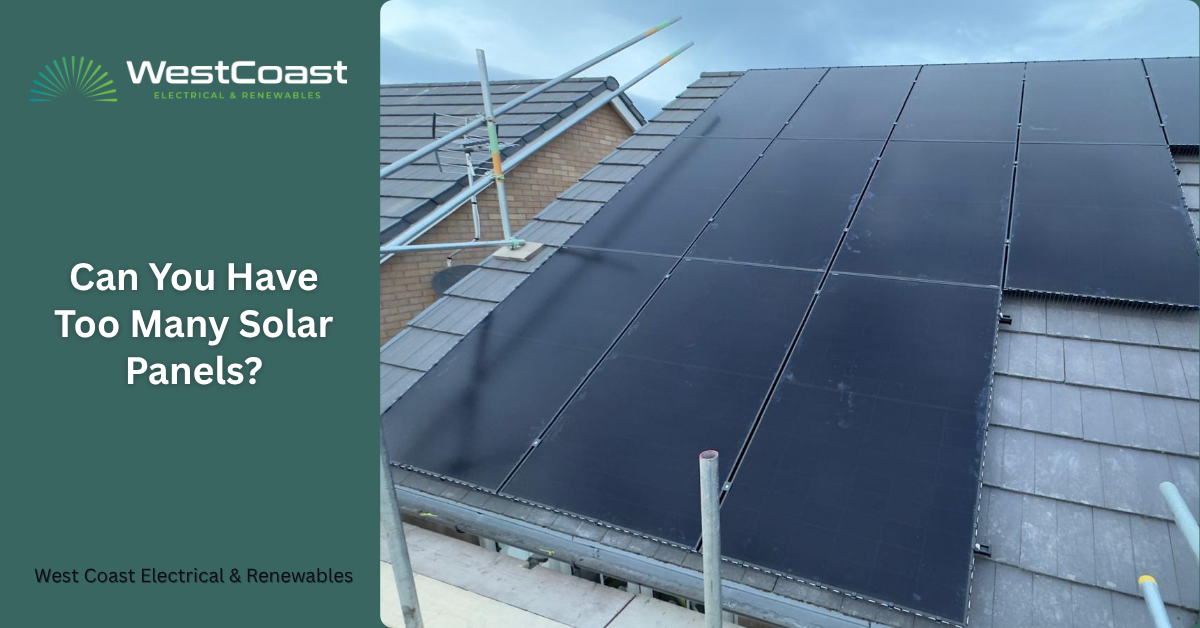
If you are trying to maximise the amount of electricity you generate at home, you might wonder whether you can have too many solar panels. If there is plenty of available roof space, surely fitting as many panels as possible is always the best option?
Not necessarily.
The right number of solar panels depends on much more than the size of your roof. Your electricity consumption, roof orientation, shading, inverter design, export arrangements, battery storage and future energy plans can all influence the size of the system.
At West Coast Electrical & Renewables, we believe good solar design should focus on the complete system rather than simply fitting the highest possible number of panels.
QUICK ANSWER
Can you have too many solar panels?
Technically, a solar PV array can be larger than the amount of electricity a household regularly consumes. However, that does not automatically mean the system has been designed incorrectly.
A larger array may make sense where there is suitable roof space, particularly if the homeowner expects their electricity demand to increase. Furthermore, surplus generation may potentially be exported to the grid, subject to the relevant connection arrangements and electricity tariff.
However, bigger is not automatically better.
The important question is not simply “How many panels can we fit?”
It is “What solar PV system makes sense for this property?”
More Solar Panels vs Better Solar Design
| Consideration | Simply adding more panels | Proper system design |
|---|---|---|
| Roof space | Uses as much space as possible | Considers the most suitable usable areas |
| Electricity usage | May ignore actual demand | Considers current and future consumption |
| Inverter | Can become an afterthought | Designed alongside the solar array |
| Battery storage | May not consider storage | Can account for battery capacity and usage |
| Shading | May use less productive areas | Considers shading and panel positioning |
| Export | Assumes surplus can simply be exported | Considers grid connection and export arrangements |
| Future plans | Focuses on today’s household | Can consider EVs, heat pumps and changing demand |
| Overall aim | Maximum panel count | A suitable complete energy system |
This is why comparing solar quotations based purely on the number of panels can be misleading.
Why Would You Install More Solar Panels Than You Currently Need?
Your electricity use today may not represent your electricity use in five or ten years.
For example, you may currently heat your home using gas and drive a petrol or diesel vehicle. However, you might plan to move to an electric vehicle or install an air source heat pump in the future.
Both changes could increase household electricity demand.
Therefore, if suitable roof space is available, it can make sense to consider future requirements when designing the solar PV system.
Battery storage can also change how you use the electricity generated by your panels. Instead of relying solely on using solar electricity at the exact moment it is generated, a compatible battery system can store surplus energy for later use.
As a result, solar design should look further ahead than your latest electricity bill.
Does Your Solar Array Have to Match the Size of Your Inverter?
Not necessarily.
This is one area where solar PV becomes more technical.
Solar panels have a rated DC capacity, while an inverter has its own power rating and operating limits. Therefore, you should not assume that a 5kW solar array automatically requires an inverter with exactly the same headline rating.
Solar designers may intentionally specify a solar array with a higher rated DC capacity than the inverter’s AC output rating. This approach can help the inverter operate effectively across a wider range of conditions.
However, system designers must remain within the inverter manufacturer’s specified voltage, current and power limits.
Occasionally, the panels may be capable of producing more power than the inverter can convert at that particular moment. In this situation, the inverter limits its output. This is commonly referred to as clipping.
A small amount of clipping under certain conditions does not automatically mean the system has been poorly designed.
However, excessive oversizing could waste potential generation. Therefore, inverter selection and solar array design should form part of the same calculation.
SOLAR DESIGN FACT: The headline kW rating of your panels and inverter does not always need to match exactly. What matters is that the complete system has been designed correctly and remains within the equipment manufacturer’s specifications.
What Happens to Solar Energy You Do Not Use?
Imagine your solar panels are generating electricity during the middle of the day, but very little electricity is being used inside your home.
That electricity needs to go somewhere.
Depending on the system, surplus solar generation could charge a battery or be exported to the electricity grid.
Therefore, producing more solar electricity than you can immediately use is not automatically a problem.
However, homeowners should not assume they can export an unlimited amount of electricity.
The electricity network and connection arrangements need to be considered when designing larger solar installations. Export limits may also apply depending on the property and network requirements.
Consequently, this is another reason why simply covering every available part of the roof with panels without considering the wider system is not always the right approach.
Does Battery Storage Mean I Should Install More Panels?
It can influence the decision.
Battery storage gives you another way to use surplus solar generation. During periods when your panels produce more electricity than your home requires, compatible battery storage can store some of that energy.
You can then use the stored electricity later when household demand exceeds solar generation.
However, this does not mean that adding a battery automatically justifies installing the largest possible solar array.
Battery capacity, household consumption, expected solar generation and the way you use electricity all need to work together.
For example, installing a very large solar array alongside a relatively small battery does not necessarily mean all surplus generation will be stored. Once the battery reaches its available charging limit or state of charge, additional surplus generation may instead be exported, subject to the system and export arrangements.
Again, the complete design matters.

What About Solar Export?
Export can form an important part of modern solar PV.
Eligible households may be able to receive payment for electricity exported to the grid through arrangements such as the Smart Export Guarantee or other supplier export tariffs.
However, rates, eligibility criteria and terms vary between electricity suppliers and tariffs. Therefore, we would never recommend sizing a solar installation around an assumed export payment without considering the wider circumstances.
Tariffs can change.
Instead, the solar design should consider your property, expected generation, electricity consumption, equipment and future plans.
When Might More Solar Panels Make Sense?
There is no universal answer, but additional solar capacity may be worth considering where:
- You have suitable unused roof space
- Your electricity consumption is relatively high
- You expect your electricity use to increase
- You are considering an electric vehicle
- You are considering an air source heat pump
- You plan to add battery storage
- Your roof has different orientations that could provide generation at different times of day
- Your system design and grid connection allow for the additional capacity
However, every property is different. Therefore, these factors should form part of a proper assessment rather than being treated as a checklist that automatically means you need more panels.
Could an EV Change How Many Solar Panels I Need?
Potentially.
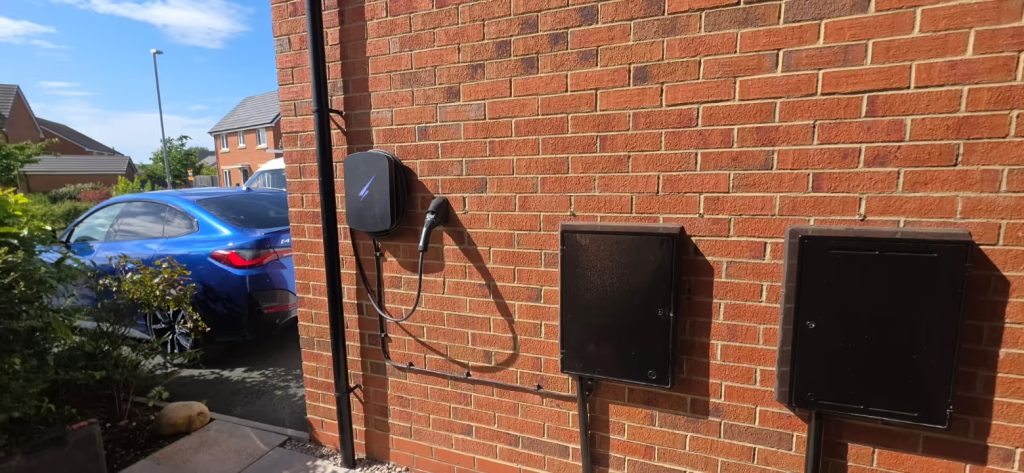
An electric vehicle moves some of your energy consumption from petrol or diesel to electricity. As a result, your household electricity demand could increase.
However, when you charge the vehicle matters too.
For example, someone who regularly charges during daylight hours may have different requirements from someone who mainly charges overnight using a time of use electricity tariff.
Therefore, we would not simply add a set number of solar panels because someone owns an EV.
Instead, it makes more sense to consider how the household uses energy as a whole.
What About an Air Source Heat Pump?
An air source heat pump also uses electricity, so installing one can significantly change a property’s electricity consumption profile.
Consequently, homeowners considering both technologies should discuss their future heating plans when obtaining a solar quotation.
Solar PV and an air source heat pump can form part of the same wider home energy strategy. However, solar generation changes throughout the year, while heating demand is typically highest during colder months when solar generation is lower.
Therefore, good design should not assume that solar panels will simply cover all of the electricity required by a heat pump.
Instead, expected annual generation and household demand need to be considered realistically.
So, How Many Solar Panels Do I Actually Need?
There is no single correct number.
Two neighbouring homes could have identical roofs but require very different solar PV systems.
One household might use relatively little electricity. Meanwhile, the other could have an EV, battery storage, an air source heat pump and much higher annual electricity consumption.
Their future plans could also be completely different.
When designing solar PV, we can consider factors including:
Available roof space: How much suitable space is actually available?
Roof orientation: Which direction do the usable roof areas face?
Shading: Are trees, chimneys or surrounding buildings likely to affect generation?
Electricity consumption: How much electricity does the household currently use?
Usage pattern: When does the household typically use electricity?
Future demand: Are an EV, battery or heat pump planned?
Equipment: Which panels, inverter and battery configuration suit the design?
Grid connection: Are there requirements or limitations that need to be considered?
Only after looking at the complete picture does the panel count become meaningful.
Bigger Does Not Always Mean Better
Solar PV is not about winning a competition for the highest number of panels on the roof.
In some properties, maximising suitable roof space may make perfect sense. In others, a smaller system may provide a better fit for the household.
The important part is understanding why a particular system has been recommended.
If one quotation includes 10 panels and another includes 16, do not automatically assume that 16 is better.
Ask why.
What generation has been estimated? Which areas of the roof are being used? What inverter has been specified? Has shading been considered? How does battery storage fit into the design? Have your future energy requirements been discussed?
Those questions tell you far more about the quality of a solar proposal than panel count alone.

Frequently Asked Questions
Is it bad to generate more solar electricity than I use?
Not necessarily. Surplus electricity may be stored in a compatible battery or exported to the grid, depending on your system and connection arrangements.
Can I fill my whole roof with solar panels?
Potentially, but available space does not automatically mean every part of the roof should be used. Roof condition, orientation, shading, access requirements, system design and other technical considerations all need to be assessed.
Should I install extra panels for a future electric car?
If you are planning to buy an EV, it is worth discussing this with your solar installer. However, the right system size depends on your wider electricity consumption and how you expect to charge the vehicle.
Is a larger solar system always more expensive?
Adding capacity generally affects equipment and installation costs. However, solar quotations depend on far more than panel count, including access, mounting requirements, inverter choice, battery storage and electrical work.
Can I add more solar panels later?
Sometimes. However, expanding an existing system can involve technical and regulatory considerations. Therefore, if you already expect your electricity demand to increase, discussing this during the original design stage can be worthwhile.
Thinking About Solar Panels in Blackpool or Lancashire?
If you are considering solar PV, the first question does not need to be “How many panels can I fit?”
A better starting point is understanding what you want the system to achieve.
At West Coast Electrical & Renewables, we design solar PV systems around the individual property and household. We can consider current electricity consumption alongside future plans such as battery storage, EV charging and air source heat pumps.
We install renewable energy systems across Blackpool, Poulton le Fylde, Thornton Cleveleys, Lytham St Annes, Preston and surrounding areas.
If you are considering solar panels and want to understand what size system could suit your property, get in touch with our team.