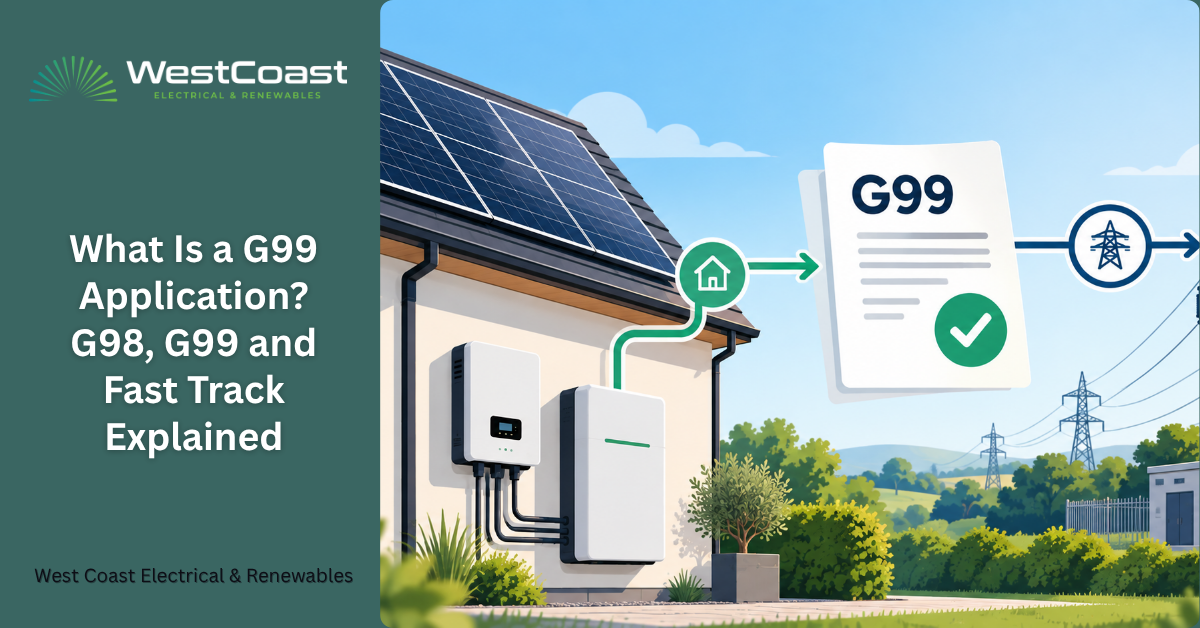
If you are planning solar panels or battery storage, you may have heard your installer mention a G99 application. You might also have come across G98, G100, DNO approval, Fast Track or commissioning documents.
It can quickly become confusing.
A G99 application is part of the process for connecting certain electricity generating equipment to the electricity distribution network. In many cases, the application must be submitted and accepted before the installation can go ahead.
However, not every solar or battery installation needs the same application. Some smaller systems can follow G98. Certain systems may qualify for G99 Fast Track, while others need to follow the standard G99 application process.
At West Coast Electrical & Renewables, we deal with this process as part of our solar PV and battery storage installations. Here is what each term actually means and why the process matters.
First, what is the DNO?
The DNO is your Distribution Network Operator.
This is different from your electricity supplier. Your supplier is the company you pay for your electricity. The DNO operates the electricity distribution network that supplies your property.
Across much of our service area in Lancashire and the North West, this is SP Electricity North West.
When you install equipment that can generate electricity, such as solar PV or certain battery storage systems, it can operate in parallel with the electricity network. Depending on the system, electricity may also be exported back onto that network.
Therefore, the DNO needs to know about the installation.
The size and design of the system determine whether we can notify them after installation or whether we need their approval first.
What is G98?
G98 covers smaller scale generation that meets specific requirements.
SP Electricity North West states that G98 applies to generation installations up to 16 amps per phase.
For a single phase property, that is up to 3.68kW. Across a three phase supply, the equivalent G98 threshold is 11.04kW.
For a qualifying installation at a single property, we do not normally have to wait for DNO approval before installing the system.
Instead, we can install and commission the compliant system and then notify the DNO.
Officially, the installer must notify the DNO within 28 days of commissioning. As part of our own process, however, we aim to send our G98 notification promptly after installation.
That makes G98 very different from G99.
G98 vs G99: What is the difference?
Here is a simple comparison.
| G98 | G99 | |
|---|---|---|
| Typical threshold | Up to 16A per phase | Generation outside the applicable G98 limits |
| Single phase G98 limit | Up to 3.68kW | Typically applies when generation exceeds the G98 threshold |
| Application before installation? | Normally no for a qualifying single premises installation | Yes |
| Can we install immediately? | Normally yes if the installation meets G98 requirements | We normally need the appropriate DNO response first |
| DNO involved? | Yes | Yes |
| Commissioning information required? | Yes | Yes |
| Can Fast Track apply? | Not applicable in the same way | Yes, but only for qualifying installations |
The important point is that G98 and G99 are not optional certificates.
We cannot simply choose whichever route is quickest. We assess the equipment, inverter capacity, battery storage, existing generation and proposed system to determine the correct connection process.
What is a G99 application?
G99 covers the connection of generation equipment that falls outside the relevant G98 process.
For many domestic customers, the biggest practical difference is timing.
With G98, a qualifying system at a single premises can normally be installed and then notified.
With G99, we normally need to apply before installation.
The DNO then assesses the proposed system and how it will interact with the local electricity network.
This is why you may receive a solar quotation and then be told that we need to submit a G99 application before we can proceed with the final installation.
It does not mean there is a problem.
It simply means the DNO needs to assess the proposed connection first.
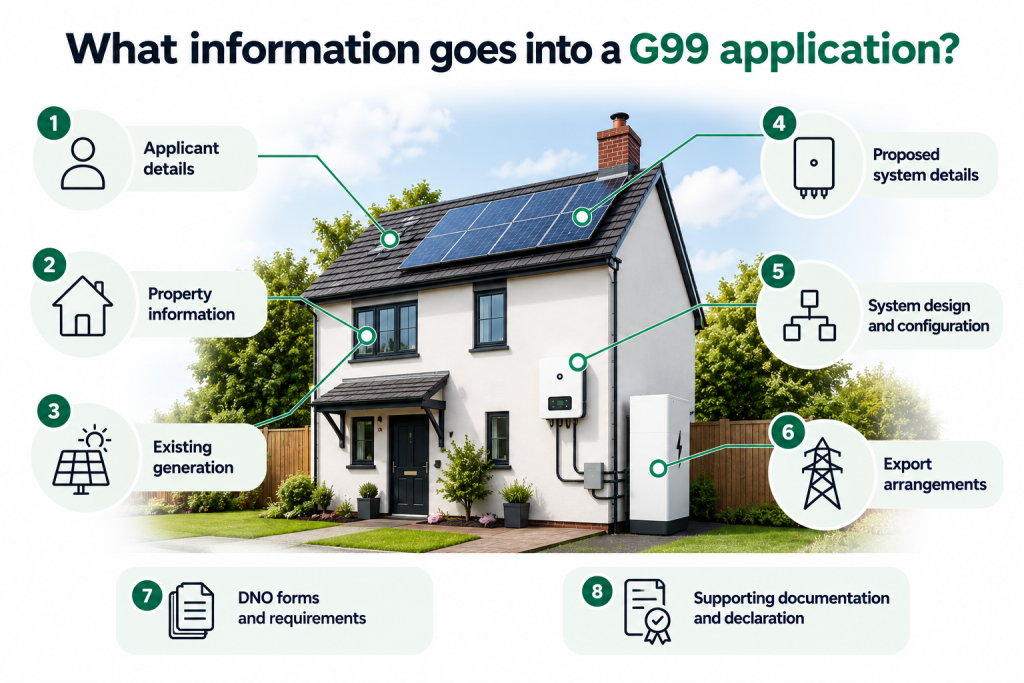
What information goes into a G99 application?
There is much more involved than simply telling the DNO how many solar panels you want.
Depending on the application, information can include:
- Your MPAN and property details
- Existing solar PV or other generation at the property
- Proposed additional generation
- Battery storage
- Inverter manufacturer and model
- Intrinsic Design Capacity
- Registered Capacity
- Proposed export capacity
- G100 export limitation, where applicable
- Type Test information
- Target installation date
- A Single Line Diagram showing how the electrical system will be connected
This information allows the DNO to understand what is actually being connected to its network.
That is also why two customers having a similar number of solar panels may not necessarily follow exactly the same application route.
Can we Fast Track a G99 application?
Potentially, but this is where it is important to be accurate.
Not every G99 application can be Fast Tracked.
SP Electricity North West has a G99 Fast Track process for qualifying small generation and storage installations. However, the proposed installation has to meet specific technical criteria.
For its current Fast Track process, SP Electricity North West states that the Intrinsic Design Capacity must be 32A or less, while the Aggregate Registered Capacity of all power generating modules must be 60A or less.
The installation must also meet the requirements of one of the relevant Small Generation Installation categories, known as SGI 1, SGI 2 or SGI 3.
In addition, generating units connected through this process, including electricity storage, must use appropriate G98 or G99 Type Tested inverters.
Therefore, being above the G98 limit does not automatically mean we can use G99 Fast Track.
We need to look at the complete design first.
What are SGI 1, SGI 2 and SGI 3?
SGI stands for Small Generation Installation.
These routes allow certain smaller generation and storage arrangements to follow the G99 Fast Track process when they meet the required technical conditions.
The exact route depends on the configuration of the installation, including factors such as existing generation, new generation, battery storage, inverter capacities and how export is controlled.
This becomes particularly relevant when customers already have solar panels and want to add battery storage.
We cannot simply look at the new battery in isolation. The existing equipment and proposed additional equipment need to be considered as part of the overall installation.
Therefore, before telling a customer that their system can be Fast Tracked, we first establish whether it actually meets the applicable SGI criteria.
What is G100 and export limitation?
You may also hear us mention G100.
G100 relates to export limitation schemes.
An export limitation scheme can control the maximum amount of electricity that an installation exports onto the distribution network.
For example, the generating and storage equipment installed at a property may have a higher overall capacity than the amount the DNO permits the property to export.
A suitable export limitation scheme can control that export.
However, this is another area where there is often confusion.
Adding export limitation does not automatically mean that a system qualifies for G99 Fast Track.
The DNO application still needs to consider the overall design, equipment capacities, existing generation and applicable G99 requirements.
Why does the DNO need to approve G99 before we install?
The electricity network was not originally designed around every property generating and exporting significant amounts of electricity.
As solar PV and battery storage become more common, the DNO needs to manage factors such as network capacity, voltage and power quality.
Therefore, when we submit a G99 application, the DNO assesses whether the proposed generation can connect to the network and whether any conditions need to apply.
In some cases, the proposed system may be acceptable as designed.
In other cases, the DNO may place a restriction on the connection, request additional information or identify network work that is required.
This is why we cannot guarantee a G99 outcome before the DNO has assessed the application.
What happens during a G99 application?
For the customer, the process generally looks something like this:
System design → G99 application → DNO assessment → DNO response → installation → commissioning → commissioning documents submitted → DNO records updated
The first stage is designing the proposed solar or battery system.
We then establish which connection process applies. If G99 approval is required, we prepare the relevant information and submit the application to the DNO.
The DNO assesses the proposed connection.
Once we have the appropriate response and can proceed in accordance with it, we install and commission the system.
The process does not end when the panels and battery are working, though.
We also need to complete the post installation documentation.
What happens after we install a G99 system?
Once the approved system has been installed, we commission it and complete the required documentation.
SP Electricity North West states that installers must provide an Installation Commissioning Confirmation within 28 days of each generating unit being commissioned.
For G99 compliant schemes, commissioning documents are sent back to the named designer shown on the DNO offer or notification correspondence.
This closes an important part of the connection process.
So, when we talk about a G99 application, there are effectively two sides to it.
There is the work required before installation, and there is further documentation required after commissioning.
Why might I need the DNO acceptance or response afterwards?
Keep your DNO documentation with your solar and electrical paperwork.
This can become particularly important when arranging an export tariff with an energy supplier.
Your supplier may require evidence that the generating installation has been correctly notified to and recorded by the DNO.
Therefore, once the relevant DNO process has been completed, the documentation can form part of the evidence needed when setting up export arrangements.
The DNO and your electricity supplier are separate organisations, so completing your solar installation does not automatically mean your export tariff is set up.
How long does a G99 application take?
This is one of the most common questions we receive, but there is no single timescale that accurately covers every G99 application.
The time required depends on the application route and the proposed connection.
A qualifying G99 Fast Track installation follows a different process from a standard G99 application. Likewise, an application that needs additional technical assessment or network work can take longer than a straightforward connection.
The quality of the information submitted also matters. Missing equipment information, incorrect capacities or an incomplete Single Line Diagram can create avoidable delays.
Therefore, we prefer not to promise customers an exact G99 approval date before the DNO has reviewed the application.
If you are planning solar panels or battery storage for a particular date, it is worth allowing time for the DNO process rather than assuming installation can take place immediately.
Does needing G99 mean my solar system is too big?
Not necessarily.
It simply means the proposed generation falls within the G99 connection requirements rather than the relevant G98 process.
For some customers, a larger solar PV array or more capable inverter makes sense because of their electricity consumption, available roof space and future energy plans.
However, the electrical design and DNO requirements need to form part of that decision.
We would rather design the right system and follow the correct connection process than reduce a system simply to avoid paperwork.
What about adding a battery to existing solar panels?
This is another situation where G98 and G99 become particularly important.
If you already have solar PV and want to add battery storage, we first need to understand what is already installed.
We may need details of the existing inverter, its capacity, the original DNO notification or approval and the proposed battery system.
We can then assess the combined arrangement and establish the appropriate connection route.
This is why adding a battery is not always simply a case of fitting the equipment and switching it on.

Why does all this matter to the homeowner?
You do not need to become an expert in G98, G99, G100 or DNO application forms to have solar panels installed.
However, you should use an installer who understands them.
The DNO process affects how generation equipment connects to the electricity network. Therefore, it needs to be considered during system design rather than treated as paperwork to sort out afterwards.
At West Coast Electrical & Renewables, we assess the proposed installation, determine the appropriate DNO route and deal with the required application or notification as part of the project.
For G98 installations, that means completing the relevant notification following commissioning.
Where G99 applies, it means establishing whether the installation meets the requirements for Fast Track or requires the standard G99 process, submitting the relevant information before installation and completing the required commissioning documentation afterwards.
G98 or G99? The simple version
If you have reached this page because someone has mentioned G99 and you are wondering what it means, remember these key points.
G98 generally applies to qualifying smaller generation systems up to 16A per phase.
G99 applies where the proposed generation falls outside the relevant G98 requirements.
G99 Fast Track is available for certain qualifying installations only. It has specific technical criteria and is not automatically available simply because a system is relatively small.
G100 relates to export limitation and may form part of the design where the amount exported to the network needs to be controlled.
Most importantly, G99 normally needs to be dealt with before the installation takes place, followed by the appropriate commissioning documentation once the system has been installed.
Need help with a G99 application or solar installation?
If you are considering solar PV or battery storage in Blackpool, Poulton le Fylde, Thornton Cleveleys, Lytham St Annes, Preston or elsewhere across Lancashire, West Coast Electrical & Renewables can assess the proposed system and establish which DNO process applies.
Whether your installation falls under G98, qualifies for G99 Fast Track or requires a standard G99 application, we can handle the relevant process alongside the design and installation of your renewable energy system.