If you are considering solar panels, you might wonder what happens when your panels generate more electricity than your home needs. Does that extra solar power simply disappear, or can you make use of it later?
The good news is that unused solar power does not necessarily have to go to waste. Depending on your setup, surplus electricity can charge a battery or export to the electricity grid.
Understanding where your solar energy goes can help you decide whether solar panels alone are right for you or whether adding battery storage could make your system more flexible.
At West Coast Electrical & Renewables, we install solar PV and battery storage systems across Blackpool, Poulton le Fylde, Thornton Cleveleys, Lytham St Annes, Preston and surrounding areas.
Your Solar Panels Start Generating Electricity
Solar panels generate electricity when daylight reaches the solar cells. Therefore, they do not need hot weather or constant bright sunshine to operate.
Naturally, generation changes throughout the day and across the seasons. A bright summer afternoon could produce considerably more electricity than an overcast winter evening.
Meanwhile, your household electricity demand constantly changes too.
You might have the washing machine running in the morning, very little electricity use during the afternoon and then much higher demand when everyone comes home.
This creates an important question.
What happens when your solar panels are producing more electricity than your home is using?
The answer depends on your solar setup.
Solar Energy Usually Goes to Your Home First
When your solar PV system is generating electricity, your home can use that electricity as it is produced.
For example, imagine your solar panels are generating 3kW and your property is using 1kW at that moment. The solar system can contribute towards that 1kW demand.
That leaves surplus generation available.
Without battery storage, surplus electricity can usually be exported to the electricity grid, subject to your system configuration and connection arrangements.
With battery storage, however, you may have another option.
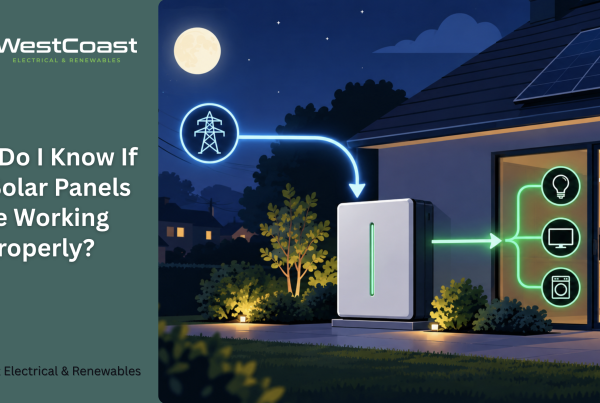
A simple way to picture it
SOLAR PANELS
↓
YOUR HOME
↓
BATTERY STORAGE
↓
ELECTRICITY GRID
The exact flow will depend on your system settings, battery state of charge, household demand and other factors. However, this gives you a simple idea of how solar generation can move around a modern home energy system.
What If I Have Solar Battery Storage?
Adding a battery gives you greater control over when some of your electricity is used.
When your panels produce more electricity than your home needs, compatible battery storage can store surplus generation rather than immediately exporting all of it.
Later, when solar generation falls and your household demand increases, the battery can discharge stored electricity to support the home.
For example, your solar panels may generate strongly around midday while nobody is home. Your electricity demand might then increase at 6pm when you start cooking, using appliances and spending more time indoors.
A battery can help move some of that available energy from one part of the day to another.
However, battery storage is not simply about storing every spare unit of solar electricity.
Modern battery systems can offer much more flexibility.
Battery Storage Can Work Around Electricity Tariffs Too
One of the most useful features of modern battery storage is the ability to charge from the grid as well as from solar, where the system and tariff allow it.
For example, some customers choose to charge their battery during cheaper off peak electricity periods. They can then use stored electricity when grid prices are higher.
In some circumstances, a household may even choose to export solar electricity rather than store it. The best approach depends on the import and export rates available through the customer’s electricity supplier.
Therefore, there is no single setup that works best for every property.
Electricity tariffs, household consumption, solar generation, battery capacity and individual priorities all matter.
Electricity tariffs and export rates vary between suppliers and can change. Always check the current terms and rates offered by your chosen energy provider.
Can I Sell Unused Solar Electricity Back to the Grid?
Potentially, yes.
The Smart Export Guarantee, usually shortened to SEG, requires certain licensed electricity suppliers to offer an export tariff to eligible small scale low carbon generators.
This means eligible households can receive payment from an electricity supplier for electricity exported to the grid.
However, export rates vary between suppliers and tariffs. Eligibility requirements also apply, so you should check the current tariff conditions before calculating potential returns.
This is also one reason why choosing a properly designed solar installation matters.

West Coast Electrical & Renewables is an MCS certified installer and a RECC member, helping customers choose systems designed around their property and expected electricity use.
Should I Store My Solar or Export It?
This is where solar and battery storage becomes particularly interesting.
There is not one answer that applies to everyone.
For some households, storing more solar electricity for use later may make sense. However, another household could have an attractive export tariff and prefer to export more electricity while charging its battery at a cheaper time.
Your daily routine matters too.
Someone who works from home may naturally use more solar electricity during daylight hours. In contrast, a household that is empty throughout the working day could have much more surplus generation available.
That is why we look at the property and the customer rather than simply recommending the largest possible solar or battery system.
A well planned system should reflect how you actually use electricity.
Where Does My Solar Electricity Go?
Modern monitoring makes this much easier to understand.
Depending on the equipment installed, an app can allow you to see information such as:
• Current solar generation
• Household electricity consumption
• Battery charge level
• Electricity imported from the grid
• Electricity exported to the grid
Instead of simply knowing that your solar panels are generating, you can see how electricity is moving around your property.
Over time, this information can also help you understand your energy habits.
For example, you may decide to run certain appliances when solar generation is higher. Alternatively, battery settings can sometimes be adjusted around suitable electricity tariffs.
Do I Need a Battery With Solar Panels?
No. Solar panels can operate without battery storage.
However, a battery can give you additional options for managing the electricity your solar panels generate.
Whether it is worthwhile will depend on factors including your household consumption, when you use electricity, your solar system size, available tariffs and what you want your system to achieve.
Some customers install solar panels and battery storage together. Others already have solar panels and decide to add battery storage later.
There is no need to copy somebody else’s setup.
Instead, your system should be designed around your own property.
What Happens When the Battery Is Full?
Once a battery reaches its permitted state of charge, additional surplus solar generation cannot simply continue charging it.
If your panels are still producing more electricity than the property needs, that surplus can normally export to the grid, depending on the installation setup and any applicable export limitations.
Solar generation can also be controlled where necessary by the system.
Again, this highlights why solar PV, battery storage, inverter selection and grid connection requirements should be considered together.
Designing Solar Around Your Home
The number of panels on your roof is only one part of a solar installation.
At West Coast Electrical & Renewables, we look at the wider energy system.
That can include your current electricity consumption, roof space, shading, expected solar generation, inverter specification, battery capacity and potential future requirements.
For example, you might currently want solar panels but plan to add an EV charger or air source heat pump later. Considering future electricity demand at the design stage can help create a system that better suits your longer term plans.
We install renewable energy systems for homes across Blackpool, Poulton le Fylde, Thornton Cleveleys, Lytham St Annes, Preston and the wider Lancashire area.
Our renewable services include solar PV, battery storage, EV charging and air source heat pumps.
Make More of the Electricity Your Home Generates
So, what happens to solar power you don’t use?
It depends on your system.
Your home can use solar electricity while it is being generated. If generation exceeds demand, compatible battery storage may store some of that surplus for later. Alternatively, electricity can be exported to the grid, subject to the system setup and relevant connection arrangements.
More importantly, modern solar systems give homeowners much greater visibility over how electricity moves around their property.
If you are considering solar panels or battery storage, West Coast Electrical & Renewables can design a system around your property, electricity use and future plans.