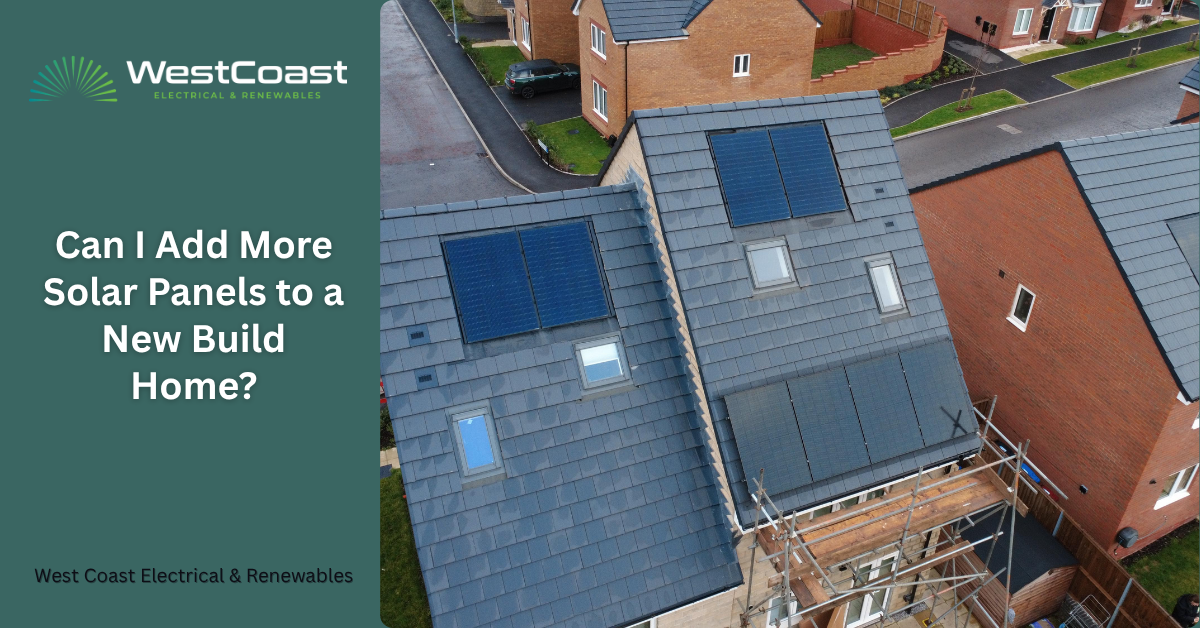
If you have bought a new build with solar already installed, you may be wondering whether the original system is enough for your household. Many new homes now include solar PV as part of their energy efficient design. However, the system installed by the developer may not always reflect the amount of electricity your family will actually use.
So, can you add more solar panels to a new build home? In many cases, yes. Depending on the existing system, available roof space and electrical setup, you may be able to increase your solar capacity. You could also consider battery storage, EV charging and an air source heat pump as part of a wider home energy system.
Why Do New Build Homes Have Solar Panels?
Solar PV has become increasingly common on new developments as housebuilders work to meet energy efficiency requirements under Building Regulations.
However, there is an important distinction to make.
Under the current requirements applying to many new homes, there is not one fixed number of solar panels that every developer must install. Instead, new homes must meet specific energy performance targets.
The design of the property, insulation, glazing, heating system, ventilation and renewable technologies can all contribute towards achieving those targets.
Therefore, the solar PV installed by a developer may form part of the property’s overall Building Regulations compliance. It has not necessarily been designed around the electricity consumption of the family who eventually moves into the property.
For example, a couple using relatively little electricity could have very different requirements from a family with an electric vehicle, electric cooking, home working and other high demand appliances.
Government Requirements for Solar on New Builds
Requirements for new homes are continuing to change.
The Government published the Future Homes and Buildings Standards in March 2026. Updated Building Regulations introduce a specific requirement for onsite renewable electricity generation for new dwellings.
For most suitable properties, solar PV is expected to play an important role in meeting these requirements.
The new requirements are due to come into force from 24 March 2027, although transitional arrangements apply to developments that are already underway.
New homes built to the updated standards will also need high levels of energy efficiency and low carbon heating.
As a result, technologies such as solar PV and heat pumps are likely to become an increasingly normal part of new home construction.
However, there is still an important difference between meeting Building Regulations and designing a renewable energy system around the needs of a particular household.
Is the Solar on My New Build Big Enough?
This depends on how much electricity your household actually uses.
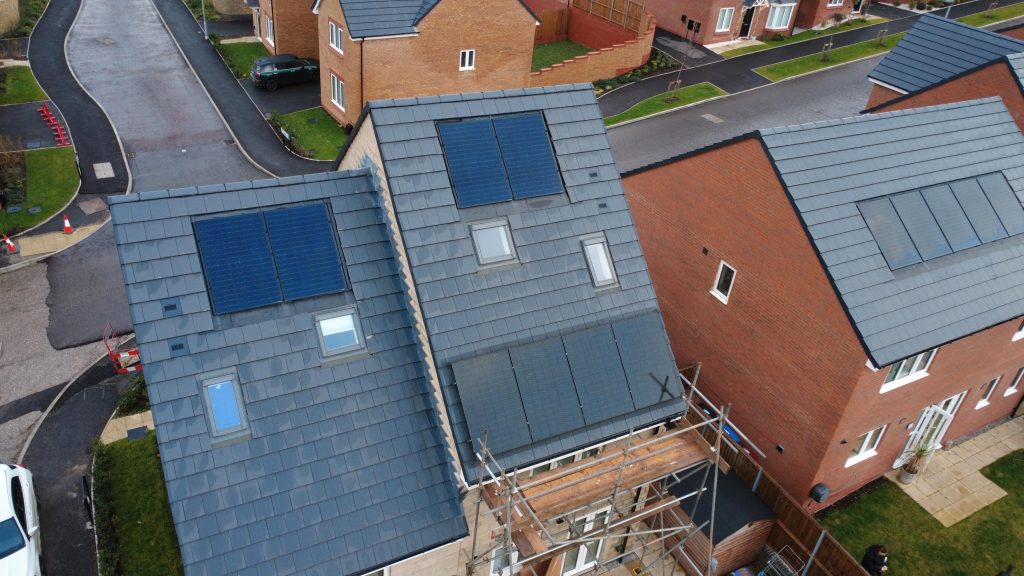
You may have moved into a new build with a relatively small solar array. Although that system will still generate renewable electricity, there could be enough usable roof space to install considerably more solar capacity.
Rather than looking only at the number of panels already installed, we consider:
- Your annual electricity consumption
- The size of the existing solar system
- The existing inverter
- Available roof space and orientation
- Shading around the property
- Daytime and evening electricity consumption
- Whether you own an EV
- Whether you have or plan to install an air source heat pump
- Whether battery storage would suit your usage
- Your current electricity tariff
Looking at the complete picture helps us design a system around how your household actually uses electricity.
Can I Add More Solar Panels to My New Build?
In many cases, you can add more solar panels to an existing new build installation. However, the original system needs to be assessed first.
Adding solar is not always as straightforward as connecting additional panels to the existing system.
For example, we need to consider the specification and capacity of the existing inverter. We also need to assess the panels already installed, available roof space and the electrical design of the system.
In some cases, extending the existing installation may be suitable. Alternatively, installing an additional system or redesigning part of the original installation may be a better option.
Grid connection requirements also need to be considered. Depending on the proposed system size and export capacity, the relevant Distribution Network Operator requirements will apply.
At West Coast Electrical & Renewables, we assess what is already installed before recommending the most appropriate way to increase the system.
Should I Add Battery Storage Too?
If you plan to add more solar panels, battery storage is certainly worth considering at the same time.
Without battery storage, your home can use solar electricity while the panels are generating it. Any electricity you do not use at that time may then be exported to the grid.
A battery gives you another option.
For example, your solar panels may generate more electricity during the middle of the day while nobody is home. A battery can store some of that surplus generation so you can use it later when household demand increases.
However, battery storage is not only useful for storing solar energy.
Modern battery systems can also work alongside compatible smart electricity tariffs. Depending on your tariff and energy consumption, you may choose to charge the battery during a cheaper overnight period. You can then use some of that stored electricity when grid electricity is more expensive.
The most suitable approach will depend on your electricity consumption, solar generation, battery capacity and tariff.

What If My New Build Has an Air Source Heat Pump?
An air source heat pump can significantly change the way a household uses electricity.
Unlike a gas boiler, an air source heat pump uses electricity to provide heating and, in many installations, hot water. Therefore, it is important to consider this additional electrical demand when looking at solar and battery storage.
If your new build already has an air source heat pump, or you are considering having one installed, we can factor this into the overall system design.
However, it is important to be realistic about seasonal generation.
Installing more solar panels does not mean your solar system will continuously power an air source heat pump throughout the year. Solar generation changes with daylight, weather and the seasons. Meanwhile, heating demand is usually highest during winter when solar generation is lower.
Therefore, solar PV, battery storage, an air source heat pump and a suitable electricity tariff should be considered as parts of a wider home energy system.
What About Adding an EV Charger?
An electric vehicle can also considerably increase household electricity consumption.
If you bought a new build with a small solar installation and later purchased an EV, the original solar system may not have been designed with that additional electricity demand in mind.
However, adding enough solar panels to cover EV charging should not automatically be the objective.
For some households, charging an EV overnight on a suitable lower rate electricity tariff can be more cost effective. Meanwhile, solar generation can support general household demand, charge battery storage or potentially be exported to the grid.
Again, there is no single setup that suits every household.
Your annual mileage, charging habits, solar generation, battery capacity and electricity tariff all need to be considered.

Designing Solar Around Your Actual Energy Usage
Building Regulations provide important standards for new homes. However, regulatory compliance and a personalised renewable energy system are not the same thing.
Once you are living in the property, you have something particularly useful: real energy consumption data.
We can look at how much electricity your household uses throughout the year and consider any future changes. For example, you may be planning to purchase an EV, install battery storage or move from another heating system to an air source heat pump.
This allows us to design around the property and the people actually living there.
Therefore, if your new build only has a small solar installation, it does not necessarily mean you are limited to that system.
Add More Solar Panels to Your New Build
If you are considering whether to add more solar panels to your new build, the first step is understanding what you already have.
West Coast Electrical & Renewables installs solar PV, battery storage, EV chargers and air source heat pumps across Blackpool, Poulton le Fylde, Thornton Cleveleys, Lytham St Annes and the wider Lancashire area.
We can assess the existing solar installation, your available roof space and your household electricity requirements. From there, we can look at whether additional solar panels, battery storage or a wider home energy system would suit your property.